
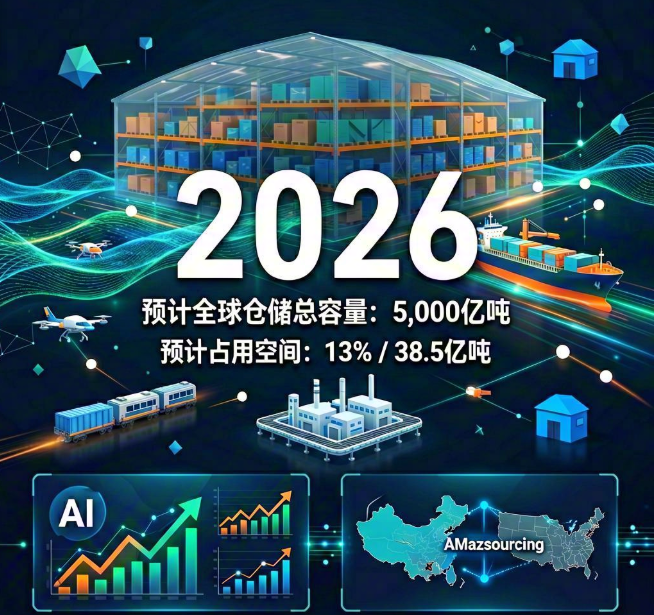
For Amazon third-party sellers, 2026 marks a subtle turning point. Platform competition is intensifying, operating costs keep rising, and profit margins are being squeezed from all sides. Meanwhile, Amazon has unveiled its four key business strategies for 2026, focusing on “AI-driven innovation,” “borderless expansion,” “smart global logistics,” and “local empowerment,” with more than 40 initiatives designed to help sellers grow.
Against this complex backdrop, sourcing competitiveness has become a critical variable that determines seller success. Supply chain management directly impacts cost, efficiency, and daily operations. Sourcing is no longer just “buying things” – it is a core capability for building long-term competitive advantage. This article analyzes the real challenges Amazon third-party sellers face in 2026 and explores next‑generation sourcing strategies to help you build a more resilient supply chain in a margin‑squeezed era.
1. The New Sourcing Reality of 2026: Why Old Mindsets No Longer Work?
In the past, many Amazon sellers followed a simple sourcing logic – find the cheapest supplier on 1688 or other B2B platforms, ship to an Amazon warehouse, and let operations handle the rest. In 2026, however, this approach is being challenged on multiple fronts.
Margins are under continuous pressure. Rising PPC costs, higher fulfillment fees, and stricter compliance requirements force sellers to find profit room upstream – in raw materials, production, and sourcing.
Supply chain risks are escalating. Changing trade policies, tariff fluctuations, and geopolitical factors make supplier stability more important than ever. As one analysis pointed out, “a single sourcing mistake can wipe out 55.6% of gross margin” – a risk that importers operating under new 2026 tariff rules cannot afford to ignore.
Buyers’ expectations for quality and speed keep rising. Amazon customers are used to fast delivery and high‑quality experiences. Any delay or quality defect in the supply chain can directly hurt your listing ranking and customer feedback.
Given these challenges, relying on “lowest price sourcing” is no longer sustainable. Amazon sellers need a more systematic, data‑driven, and risk‑aware sourcing strategy.
2. The Core Pillar of Next‑Gen Sourcing: One Great Partner Beats Years of Trial and Error
For most third‑party sellers, an efficient sourcing strategy does not require becoming a sourcing expert – it requires finding the right partner. A professional sourcing service company can act as your supply chain “external brain” and deliver critical value:
Lower total cost of ownership (TCO). Professional sourcers have stronger factory negotiation power and order consolidation capabilities. They help you secure better prices and payment terms. More importantly, they evaluate costs across the entire product lifecycle, not just the unit price.
Stricter quality control. In 2026’s platform environment, product quality directly affects customer experience, store ratings, and return rates. A professional sourcing partner has mature QC processes – from supplier screening and factory audits to in‑production follow‑up and pre‑shipment inspection – reducing your product quality risks significantly.
Faster response times. Market opportunities come and go. The time from product selection to FBA inbound determines whether you can capture a trending product. A professional sourcing partner can drastically shorten that timeline, giving you a precious window in fierce competition.
For a China‑based sourcing service like AMazsourcing, deep local roots in Chinese supply chains are being turned into a core advantage that helps global Amazon sellers reduce costs and improve efficiency.
3. AI‑Powered Sourcing: How Technology Is Reshaping Procurement in 2026
AI is deeply transforming every part of cross‑border e-commerce. According to Amazon, AI applications in supply chain management have moved from concept to practice – forecasting inventory, evaluating supplier quality, recommending replenishment strategies, and helping sourcing teams make more accurate decisions.
For Amazon third‑party sellers, AI‑powered sourcing means:
Sourcing decisions shift from experience‑driven to data‑driven. With AI tools, sellers can more clearly identify seasonal demand patterns, which suppliers perform best, and which product categories offer tariff optimization opportunities.
Automation and transparency improve. From RFQ to order placement, production tracking to logistics monitoring, AI is automating tasks that used to require heavy manual follow‑up. This frees up sellers to focus on product selection and brand building.
Building a resilient supply chain. As Amazon Business has shown, modern sourcing aims to achieve a state where “resilience and efficiency no longer conflict” – you need both continuous supply assurance and long‑term competitive advantage. AI helps sellers find balance between these seemingly contradictory goals.
For small and medium sellers without an in‑house tech team, choosing a sourcing partner equipped with AI capabilities is far more practical than building your own sourcing system.
4. Practical Guide: How to Choose a Sourcing Partner in 2026
With so many service providers in the market, how do you pick a reliable sourcing partner? Focus on these four dimensions:
1. Experience and industry resources. An ideal partner should have deep industry experience and a strong network of stable factories. They not only know which factories make good products, but also which factories have available capacity at different times, and which have stable management. Understanding a factory’s key customers, quality system, and the owner’s business philosophy is the first step in a thorough supplier evaluation.
2. Transparent communication processes. The biggest pain point in sourcing is information asymmetry – sellers can’t see production status, QC results, or logistics updates. A good sourcing service establishes standardized reporting and communication mechanisms, keeping you informed at every stage.
3. Total cost optimization capability. The real value of sourcing lies not only in reducing unit price, but in optimizing total landed cost (logistics, tariffs, warehousing, capital turnover, etc.). Evaluate whether your partner can design sourcing solutions with a full‑lifecycle view.
4. Risk management and contingency planning. Supply chain risks are everywhere – delayed production, raw material price hikes, tariff changes. A reliable partner should have proven contingency plans to switch suppliers or adjust sourcing strategies when unexpected events occur.
💡 Expert tip: Start with a small trial order before committing. Before building deep cooperation with a sourcing service, place 1–2 small test orders to evaluate their process efficiency, communication quality, and QC capability. Once you find a good fit, gradually scale up – this reduces trial‑and‑error costs significantly.
5. Advantages of Sourcing from China and New Opportunities in 2026
Despite ongoing global supply chain restructuring, Chinese manufacturing remains the dominant force in cross‑border e‑commerce. As of late 2025, an estimated 60% to 70% of products sold on Amazon come from China, and 71% of U.S. sellers rely on Chinese sourcing. Chinese manufacturing is not only a major source of supply for Amazon’s third‑party ecosystem, but also a core engine of GMV growth.
For Amazon sellers in 2026, the advantages of sourcing from China remain strong:
Highly concentrated industrial clusters. From consumer electronics to home goods, apparel to pet supplies, China’s industrial clusters form the world’s most complete supply chain system. Whatever category you want to sell, you can likely find the right supply resources in one of China’s specialized manufacturing hubs.
Fast supply chain response. Chinese suppliers excel at rapid prototyping, low‑MOI production, and flexible customization. This helps sellers quickly respond to market changes and capture seasonal or trending product windows.
Cost‑performance edge. Although manufacturing costs in China have risen, at comparable quality levels the cost‑performance ratio of Chinese goods is still globally competitive. A professional sourcing partner helps you find the optimal balance between quality, cost, and speed.
Meanwhile, the Chinese government continues to promote high‑quality development of cross‑border e‑commerce. The 2026 Government Work Report explicitly calls for “promoting the expansion and regulated development of the cross‑border e‑commerce plus overseas warehouse model” and “guiding the rational and orderly cross‑border layout of industrial and supply chains.” These policy signals mean that, within a professional sourcing framework, Chinese supply chains remain the most competitive choice for Amazon sellers worldwide.
6. Conclusion: A New Definition of Sourcing Competitiveness – Let the Experts Do What They Do Best
The Amazon marketplace in 2026 belongs to sellers who build moats on the supply chain side. In an era of margin pressure and intense competition, sourcing has evolved from a back‑office support function into a strategic growth engine.
For most small to medium sellers, rather than investing time and resources to build an in‑house sourcing team, it makes more sense to partner with a professional, transparent, and trustworthy sourcing service. As Amazon executives have noted, cross‑border e‑commerce is witnessing a value shift where “supply chain management moves from a cost center to a growth engine.” The right partner helps you cut costs, improve efficiency, lower risks, and accelerate growth – and that is exactly the core value AMazsourcing delivers.
Choosing the right partner is not just about saving money – it is about paving the way for future growth. When your supply chain becomes a growth engine, your Amazon business can truly move onto a fast, sustainable track.